
Social Wellness Month: Building Healthy Relationships from the Ground Up
Every July, Social Wellness Month reminds us of something we often forget: we need each other. In a world where independence and productivity are praised, the value of human connection can sometimes be overshadowed. But healthy relationships—be they friendships, family bonds, or romantic partnerships—are not just “nice to have.” They are foundational to our mental, emotional, and even physical well-being.
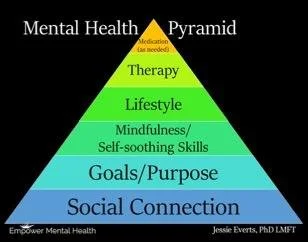
This truth is clearly reflected in the Mental Health Pyramid created by Dr. Jessie Everts, which places social connection at its base. This powerful visual, combined with the “menu, not a recipe” approach to mental health care, reminds us that while each person’s healing journey is unique, some ingredients—like connection—form the essential base for all other supports to build upon.
The Foundation of Mental Wellness: Social Connection
The Mental Health Pyramid starts at the bottom with Social Connection, followed by Goals/Purpose, Mindfulness, Lifestyle, Therapy, and finally Medication (as needed). This structure sends a strong message: without social connection, the rest of the pyramid can’t stand strong. Science backs this up. Studies show that people who maintain strong social ties have lower levels of anxiety and depression, higher self-esteem, greater empathy, and even stronger immune systems. Loneliness, on the other hand, has been linked to increased risk of chronic illness, mental health struggles, and premature death—making it as risky as smoking 15 cigarettes a day. Humans are biologically wired for connection. From infancy, our nervous systems rely on safe, secure relationships for regulation and growth. As adults, healthy relationships continue to serve as a buffer against stress, providing emotional validation, shared meaning, and a sense of belonging.
What Is Social Wellness?
Social wellness is the ability to form and maintain relationships that are supportive, honest, respectful, and meaningful. This doesn’t mean having hundreds of acquaintances or always being socially active—it’s about the quality of your relationships, not the quantity.
When you’re socially well, you:
Communicate clearly and respectfully
Set and respect boundaries
Offer and accept support
Feel a sense of belonging and connection
These relational skills don’t come automatically. Many of us have to *learn* how to nurture connection—especially if early life experiences didn’t model secure, healthy relationships. That’s why social wellness deserves intentional focus and care.
The “Menu” Approach to Mental Health
The visual you provided includes a helpful reframe: “It’s a menu, not a recipe.” That means there’s no one-size-fits-all formula for mental health. Instead, there’s a wide variety of options that can be combined and customized to meet individual needs. Social wellness is just one of the key pillars on this mental health menu, which includes:
Pharm: Medication, supplements, bloodwork, and genetic testing when needed.
Psych: Therapy, coaching, and group work to explore thoughts, behaviors, and relational patterns.
Bio-Lifestyle: Movement, nutrition, sleep, and substance use—all directly tied to mental health.
Mind-Body: Modalities like meditation, yoga, breathing practices, acupuncture, and massage to regulate the nervous system.
Spiritual: Exploring meaning, drive, purpose, or faith-based support.
Social: The relationships that ground us, mirror us, and walk alongside us.
Within this framework, social wellness is not optional—it’s the soil from which the rest of the menu grows.
How Healthy Relationships Support Mental Health
During Social Wellness Month, we’re encouraged to reflect on the state of our relationships and what role they play in our well-being. Healthy relationships provide:
Emotional Safety: A space to be seen and understood without judgment.
Co-regulation: We feel calmer and more balanced when supported by someone else’s calm presence.
Motivation: Supportive people help us stay accountable to goals and celebrate our growth.
Perspective: Conversations with trusted others can help shift distorted thinking and encourage insight.
Healing: In trauma recovery, relationships often play a central role in helping us learn that connection can be safe and fulfilling.
Cultivating Social Wellness
If connection is a need, then building relationship skills is a form of self-care. Here are a few ways to invest in your social wellness:
Practice vulnerability. Let people know how you’re really doing—beyond “I’m fine.”
Listen with presence. Put down the phone. Make eye contact. Reflect what you hear.
Set healthy boundaries. Protect your peace without closing yourself off.
Repair when needed. Apologize. Reconnect. Allow room for growth.
Reach out. Send the text. Make the call. Accept the invite—or extend one.
If you struggle with social connection due to anxiety, past trauma, or isolation, know that you're not alone. Support groups, therapy, or group coaching can offer a gentle re-entry point into building safe connections.
Integrating Relationships into Treatment: A Collaborative Approach
Dr. Patricia Pop, MD, exemplifies the kind of integrative approach that honors the importance of relationships in mental wellness. With her diverse background—from hospital psychiatry to experimental therapies and support groups for post-grad women in STEM—Dr. Pop brings deep awareness of how relational health intersects with individual well-being. She values collaboration and responsiveness, working closely with clients to build care plans that reflect their lives, their stories, and their needs. Whether you’re navigating anxiety, ADHD, or trauma, Dr. Pop’s trauma-informed, LGBTQ+ affirming, and culturally sensitive care model supports each client in creating meaningful, connected lives.
In her work—just like in the pyramid—social wellness isn’t an afterthought. It’s a foundation.
Finding Support With Dr. Patricia Pop, MD
Social Wellness Month is more than a campaign—it’s an invitation to pause and reflect on our most human need: to connect. Whether that means strengthening your marriage, rebuilding family bonds, joining a group, or just letting someone in, know this:
You don’t have to do life alone. At the base of every thriving person is a web of relationships—seen and unseen, past and present, near and far. These bonds are what ground us, lift us, and carry us forward. If you’re ready to explore how your relationships impact your mental health, and how you can cultivate greater social wellness, consider working with a provider who understands the full picture. Patricia Pop, MD brings together the science of psychiatry with the art of connection. Her integrative approach honors your unique path and supports you in building a life rooted in meaning, health, and authentic relationships.