
Bobinsana: What We Know Scientifically (Spoiler: Almost Nothing!)
Bobinsana (Calliandra angustifolia) is a beautiful, delicate fuschia flower growing along the banks of the Amazon basin on a water-loving tree. For many generations, South American people have used this plant to “open their hearts”.
With proper training and deepening, developing my own relationship to it, and working out some of the appropriation and land exploitation worries than come with using a plant from the Amazon….
it’s a medicine that I’m excited about! We’re nowhere near it yet from the medical side… but I could see a world where I’m referring to facilitators or that this is used alongside therapy work. Most likely in short 1-2 months stints. In order to deepen therapy work and loosen emotional knots and grief. In a world where we’re “blasting people into outer space” with giant doses of things… I think some of us could really use some gradual, loving, heart-opening gentleness. Sometimes, low and slow really is the way to go.
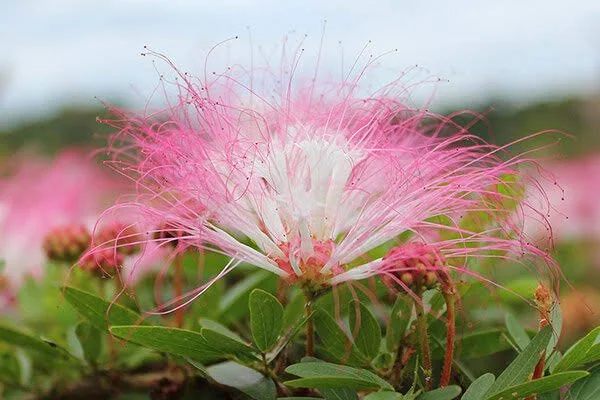
Bobinsana and its tinctures are legal (unscheduled by the DEA).
That doesn’t mean that a clinician can prescribe it though.
What does Bobinsana do?
In many shamanic traditions, plants and their effects are spoken of in anthropomorphized terms.
You’ll hear “Bobinsana, she … connects to self love, love for others, moves grief, helps with emotional release, increases empathy, connects with intuition, and activates meaningful vivid dreams.”
Other traditional uses also included hunting endurance, improved vision, increased creativity, and mental clarity.
As I repeat often: It’s beyond me to personally tell you whether the plant spirit is “real” or not.
It’s also not my place to attempt to overly reduce all traditions that are not my own through my own limited Western medical and psychotherapy lens.
So, if you see me referring to “Sirenita” as “she/her” anyways… just know that :)
In this post:
A psychiatrist's exploration of the evidence (and lack thereof)
Recently, I underwent a modern Bobinsana “dieta.”
A dieta typically consists of following guidelines that help facilitate a connection with “the spirit of the plant”. These guidelines are usually
(1) restrictions (though gentle and nonjudgmental)
(2) invitations for reflective and connecting practices
The restrictions are sometimes safety measures.
And sometimes yet another invitation for improving our “listening skills” - and clearing the pathways for enhanced ability to “tune in”. These restrictions seem (again, from my outside perspective) mainly aimed at reducing external “noise” or reducing “numbing”, so that we can better “hear” our own internal “noise” (or that of Bobinsana’s) better.
In doing this, presence, perception, and intuition are sharpened - which lays groundwork for improved capacity for compassion, communication skills, or other helpful endeavors. A prior meditation practice is not required - but goodness is it helpful!
Traditionally, people will travel to the jungle, following a strict dieta and live mostly alone in a jungle hut with the guidance of experienced shamans. The dieta in terms of food is usually extremely simple, unsalted, vegan, with no oils, fats, or flavorings. The dieta in terms of living is meant to direct you towards quiet inward reflection and reducing outer connections and noise. Most of the day consists of gentle movement, time in nature, reflection, and listening (to yourself, your thoughts, your body, your emotions, and your intuition - maybe to God/spirit/nature).
Dosing often starts low and is increased gradually, building over days to weeks of sustained use. Many practitioners describe the heart-opening, dream-enhancement, and energetic/emotional shifts as most pronounced after 7 to 14+ days of consistent work, with deepening through the full dieta period.
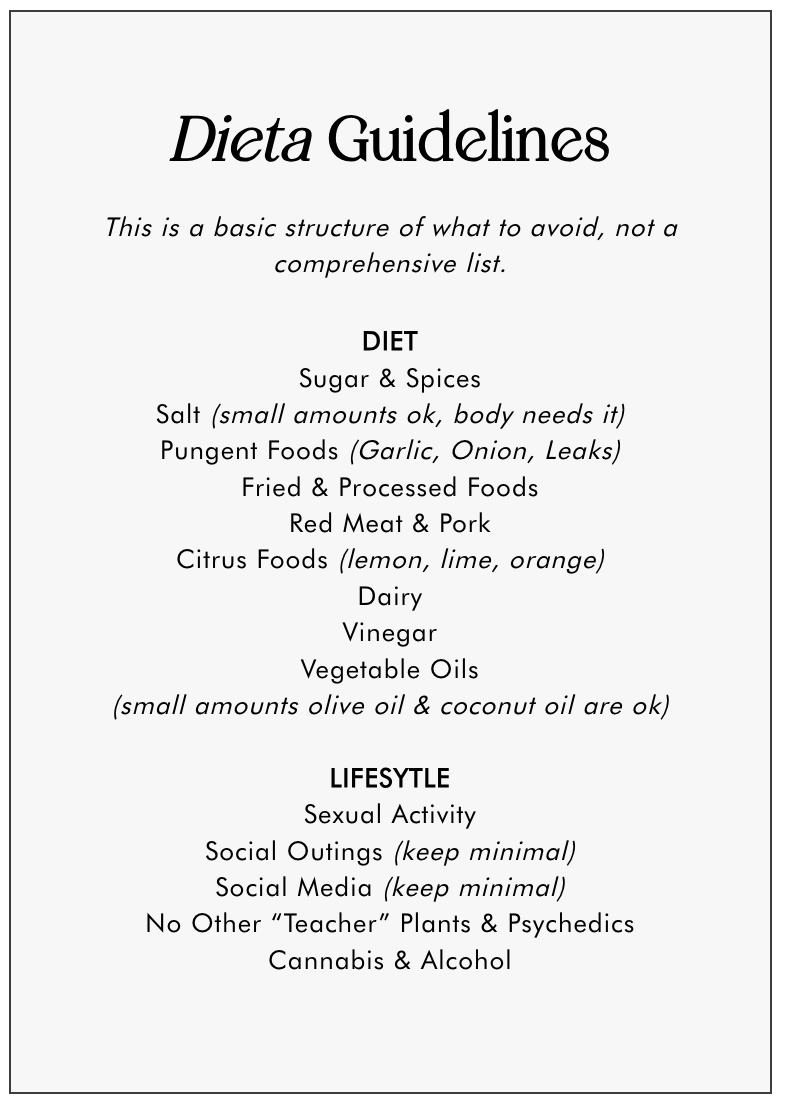
adapted from Rewild + Grow
However, the dieta that I participated in was a “modern” dieta.
They did not require us to jet over to the jungle in full isolation for weeks. Instead, with the blessing of their Amazonian teachers, our facilitators developed a way to connect with Bobinsana that is more adapted to modern living, more accessible, and possibly more eco-friendly (jet fuel and all?).
The “container” (what that really means is a whole topic) was that once per week, we would meet as a group, online, with each other and the facilitator. We would discuss a theme related to bobinsana, drink warm tea with our tincture in it together (we did it apart on other days), and listened to music, participated in singing, prayer, and guided meditation and reflection practices. There was an avenue to ask questions and discuss difficulties - both during the session and to be able to message the group or the facilitators at times outside of the weekly meeting also. This isn’t common, but there was also an online place to reflect on certain topics as the days went by, and to share your reflections and experiences too.
The restrictions were similar - essentially simple foods, little to minimal socialization or TV/social media, and no other psychoactives. They did allow a bit of salt, citing that Westerners living modern working lives will have a much harder time with a zero-salt diet (energy, fatigue).
Otherwise, we went about our days in modern daily life, gradually increasing our dosing “as tolerated” (slowing down or stopping at any point).
Yes, driving and all. While there is no research on this, it appears driving, reaction times are not impaired. An intrepid bunch, yes.
Let me hedge my own hedge, though. That's nowhere near a clinical endorsement of its safety.
Which brings me to one of the most compelling benefits of Bobinsana. Someone put it this way:
“When you take another substance - let’s say - LSD or psilocybin. Once you’ve ingested it, you bought the ticket and you’re taking the ride. You’re going! Or put another way: it whisks “you” away.
Bobinsana is more gentle. There isn’t as much of a push or override. Not only are small doses taken, but she meets you where you’re at. If you want to say “Not now Bobinsana, we’re doing expense reports!” She’ll wait. But if you invite her in, make a seat for her and say “I’m here, I’m listening” in your own way - She’ll come in, gently of course.
Your invitation, your way of listening - it will be a personal journey to find what that is for you. During long walks alone in nature, sports, art, cooking, meditation, chanting, listening to music, prayer, writing, dance, etc.”
This is true of almost all psychedelic medicines - but even moreso here. That there is an active, participatory, invitational quality that it also requires from you to do its best work with you. It is also helpful for those who are reticent to get into something “too hard too fast” with the other psychedelics.
Is Bobinsana a psychedelic?
It depends on how we define psychedelic.
My personal definition of a psychedelic (or something with psychedelic potential rather) is anything that has the ability to connect you to or show you parts of your mind/heart/soul that are deeper or beyond your awareness.
In the base sense of the term: psyche (mind or soul) + delic (manifesting, to make known),
That means psychotherapy and brainspotting can be psyche-delic. Meditation and long distance running can be.
Certain substances can also have psyche-delic poential - but they don’t claim exclusivity here either.
In much of modern research, substances will be labeled as “classic psychedelics” based on their activation of the 5HT2A serotonin receptor. Sometimes they’ll be labeled on elements of the experience (like MDMA as an “empathogen” aka “generating empathy” or Ketamine as a “dissociative”).
You also have companies trying to make “psychedelics without subjective experience” - which makes me shudder, because then they’re just neuroplastogens (being used for their effect on brain growth) derived from substances with actual psyche-delic potential. It can definitely get your head spinning - or your blood boiling depending on who you are. .
So, I think that Bobinsana does have psychedelic potential (in a much gentler way) - as well as having empathogenic or heart-opening properties that perhaps could be argued as being distinct - and many others we barely have names for (emotion-moving, grief-morphing, vivid dream enhancing, etc).
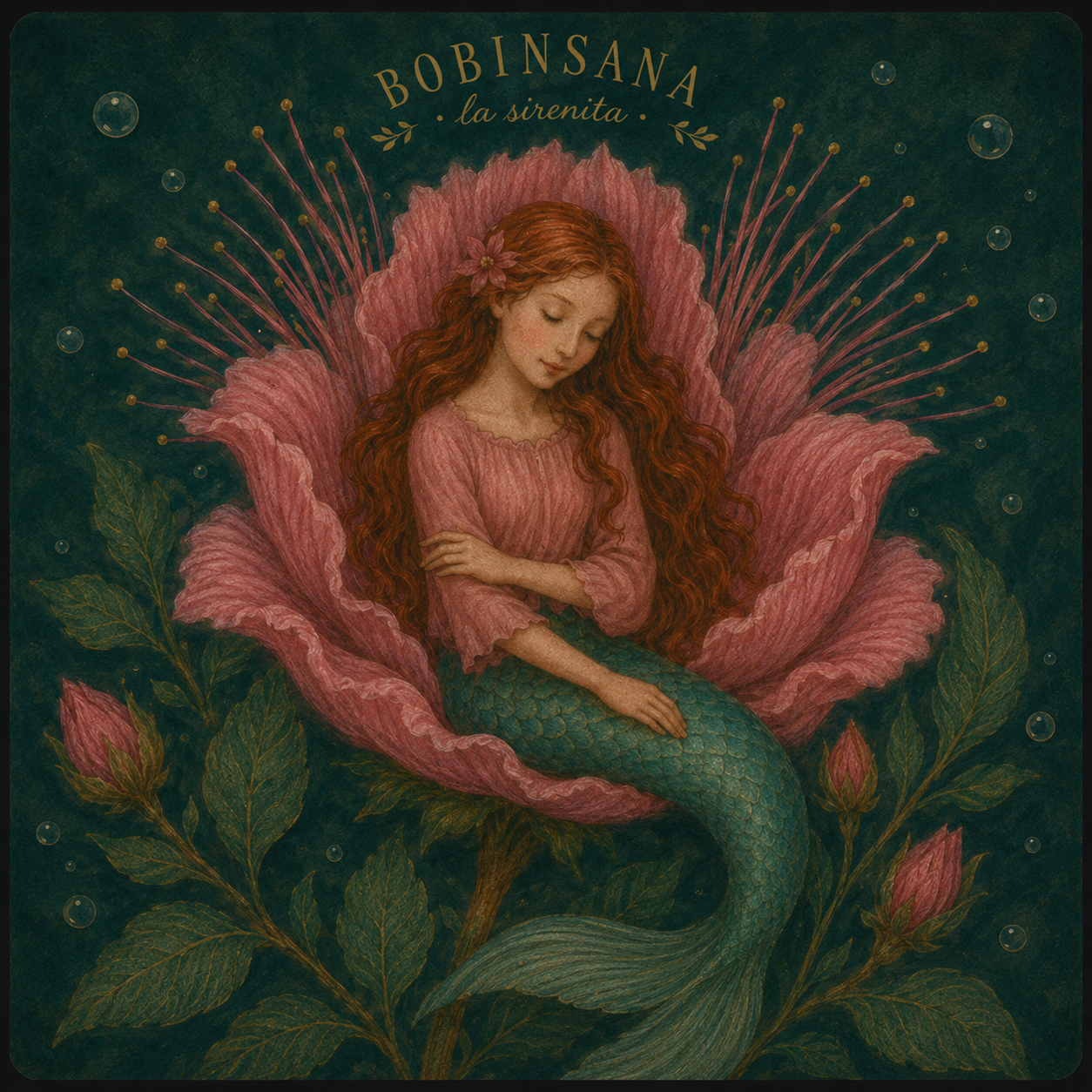
The Archetype: La Sirenita de los Rios
Bobinsana is often affectionally referred to as La Sirenita de los Rios.
To get “into the mood”, listen to these beautiful invocation melodies here:
Okra’s & Lindsey Wise , Josh Wise, & Tito La Rosa
Come with me on this anthropomorphic journey…
Rewild + Grow describes “her” as “a revered healer who encourages the purging of limiting beliefs and inspires a heart-centered perception'”.
“She illuminates any wounds in the mental and emotional bodies that make relationships with self or others difficult and transforms our egoic thinking into compassion and healthy boundaries.
Bobinsana supports us while we process our grief, loss, heartbreak, and other emotions. Every personal rejection, job loss, failed romance, betrayal, and regret, creates a sense of loss. Misplaced hopes and unmanifested dreams leave holes in our hearts.”
There is likely more depth to this representation of the Sirenita than I can grasp.
In these traditions, you will find metaphor both in the archetype and metaphors drawn from the plant’s biology that translate into how it works and helps.
However - I find this particularly striking and beautiful for the modern dieta and quite honestly, for my own existence.
The mermaid lives in the water,which holds so much symbolism relating to emotions, depth, the unknown, intuition, flow, gentle power, and “Yin” (a story for another day, but you’ll never catch me using “divine feminine” despite its widespread and even beautiful uses in New Age circles - no need to bring the traditional gender binary but I’m looking for other ways to capture this concept, like Yin/Yang superficially adapted from Chinese philosophy). Many songs and connection practices (connecting to self, emotional world, or to the mystical/diving) may involve water or related themes (ocean, rivers).
Fun sidetrack: This blog in several parts covers The Mysticism of Frozen II, including the well known song All is Found, featuring extremely psychedelic and mysticism coded metaphors involving rivers.
The plant has rootsseven times as deep as it is tall - this carries symbolism for rootedness, connection (to self, grounding, ancestors, calm), and she is said to help ground our bodies in the present.
The mermaid uses song/voice - containing symbolism relating to connection to self, self expression, and a beautiful way Sirenita “loves to” connect with you I’m told - through music and song. Sing, make sounds, listen to music, express yourself.
Most importantly for me - and for this “modern dieta” - the mermaid and this flower “lives in two worlds at once”. The flower between land and water. The mermaid literally half human, half fish.
It’s how I’ve lived a lot of my life - and a lot of my integrative work: Neither here, nor there, but also both at once. Balancing and bridging opposing worlds, weaving the two together to create something (hopefully) even more magical than with either alone.
And it’s how we approached this modern dieta too: Both living our daily lives and also increasingly connected to our shifting inner worlds with a touch of the mystical. Going around as regular human beings, with one part connected to the deeper parts of ourselves. I fell in love with the stance and the archetype, as it so deeply connects with my deepest interests, desires, and perspective.
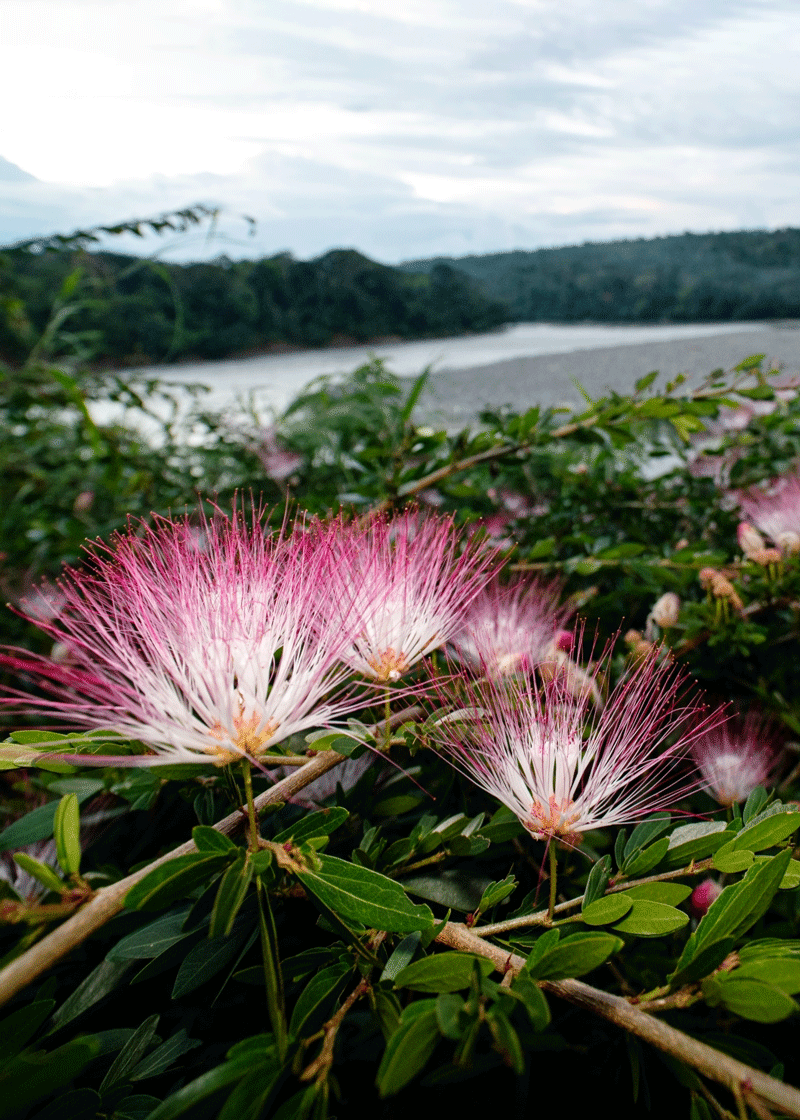
What is Bobinsana Like?
Of course, no one’s experience is exactly the same.
However, there are some generalities:
Acute ingestion (tea/tincture): Effects, when noticed at all, tend to be subtle (note: tend).
Sometimes described as a mild warmth, heart-opening, or emotional softening sensations - often reported within 30–90 minutes, but generally a softer cumulative effect. Bobinsana is generally considered a gentle effect that gradually builds over days, versus one with a dramatic acute peak.
Personal note: It was hard for me to understand this until my first night, when the first thing I experienced was that “something around my chest softened, and I didn’t even realize I was bracing before”. Cliche, but on track.
Intuition/Messaging: People describe noticing things around them and are able to extract metaphors and lessons that apply to their life. Some describe these as being actively “shown/given/revealed” (more animistic, externally generated), some describe them as “a new ability to notice or draw connection” (more internally generated). They also describe intuition and “messages” coming through - gentle soft whisper messages, not exactly heard as auditory hallucination, moreso as thoughts that arise from “a soft quiet place deep within” but that also sounds different that your usual thoughts, usually holding a peace, love, and wisdom in tone and content - that our regular day-to-day thinking … might lack sometimes :)
Dream effects: Lucid, vivid, emotionally rich, or symbolic dreams are one of the most often cited phenomena. These tend to intensify as the dieta progresses and can be refined with dream practices (setting intentions, regularly writing details down upon awakening).
This almost feels like a woefully thin section for all it could be. As it can be so rich and vivid. But the ways that these simplified experiential dimensions play out in one life versus another can create wildly different experiences.
Some things I noticed personally:
-The felt sense of heart softening, and quieting of my own agenda so that I can be even more lovingly present for others
-While listening to music or singing, having thoughts or realizations about my life and direction “come through” (that felt sense of thought deeper than thought)
-While on quiet walks in nature, waves of tears for emotional knots I hadn’t fully realized were active inside of me, and loosening afterward
-An ability to go deeper in therapy, and uncover even moreso the fuel for one of my professional fears (I was imagining a group of colleagues tearing apart my writing and online presence - I hadn’t realized that was even so active in the back of my brain! Also, hello, it’s why I’m writing at all now!)
-More connection to my desire to “be a bridge” between evidence based Western psychology/psychiatry and these approaches that help connect people to themselves and their own wisdom in an empowered way (whether through medicine induced altered states, brainspotting, etc).
(and more)
What is Known on the Western Front
What does the medical literature actually tell us about this plant's mechanism of action? Almost nothing.
What exists is ethnobotanical documentation and experiential reports from traditional dieta contexts.
When you look at peer-reviewed research on Calliandra angustifolia specifically, here's the complete mechanistic evidence: One pharmacological study from the 1990s. That's it.
Dunstan et al. (1997) in the Journal of Ethnopharmacology tested ethanol extracts of Bobinsana bark and found:
Inhibition of COX-1 prostaglandin biosynthesis in vitro (not live in humans, so we don’t know how much that really pans out in people)
No effect when applied topically (rat ear edema model)
That's the extent of our published mechanistic data. COX-1 inhibition. From one Swedish research team.
There's also Romeo et al. (1983) in Phytochemistry, which identified pipecolic acid derivatives in Calliandra species - but that's chemistry, not functional neuropharmacology.
Romeo and colleagues put out a few imino-acid papers on the Calliandra genus through the 1980s. It's all plant chemistry, though. None of it asks what any of these compounds do in a brain.
What does not exist:
Zero receptor binding studies
Zero neuroimaging data (fMRI, PET, SPECT)
Zero documentation of brain network activations
Zero human clinical trials
Zero pharmacokinetic data
Most online sources list alkaloids (calliandrine, angustine, harmane perhaps), amino acid precursors (tryptophan, tyrosine), saponins, and terpenes. But when you trace these claims back, they lead to:
Unpublished phytochemical screening
Traditional use extrapolations
Marketing copy from supplement companies
No peer-reviewed neuropharmacology.
The DMT and harmane question and Bobinsana
You'll see it written that bobinsana contains DMT and harmane (harmane being a β-carboline, the same alkaloid family as the harmala compounds in ayahuasca). Follow the citation trail and it lands in one place: Christian Rätsch's Encyclopedia of Psychoactive Plants, which says C. angustifolia and C. pentandra "have been found to contain harmane and N,N-DMT."
In that same entry, Rätsch adds that it's unknown whether anyone has ever had a psychoactive experience with the plant. That's a strange thing to place right next to "contains DMT". When I went looking for the analytical work that would actually confirm it (the LC-MS or GC-MS or NMR study that identifies and quantifies an alkaloid in this species), I couldn't find any. The plants whose DMT and β-carboline content have been pinned down in the lab are the usual ayahuasca ones: Banisteriopsis caapi, Psychotria viridis, Diplopterys cabrerana. Not Calliandra.
Bobinsana does show up as an ayahuasca admixture in some traditions, but a plant being added to a brew tells you nothing reliable about what's inside it - and it could be, and likely is, complementary yet different. And that’s how it’s typically used - as a harmonious complement (otherwise, you could just increase your dose of Ayahuasca if you wanted the same thing!).
In addition, DMT is what lands Ayahuasca on the DEA scheduling list (making it a schedule I, illegal substances under the US law) - not the alkaloids. Therefore, we’d suspect if Bobinsana did contain DMT, the DEA would probably have scheduled it already.
So: claimed, repeated widely, never confirmed, and mostly highly unlikely.
Why This Matters for Clinical Practice
I work with patients who ask about plant medicines regularly. My answer depends on the question:
"Is there evidence this works for depression/trauma/PTSD/anxiety/etc?" No randomized controlled trials exist.
"Can I do take Bobinsana if I'm on an antidepressant?" First, I cannot legally and ethically recommend this be taken on as an evidence-based clinical treatment. It’d be more like answering “can I relax with chamomile tea if I’m also taking Prozac?” But this is an important safety concern.
I want to be clear that it's unconfirmed - β-carbolines like harmane are reversible MAO inhibitors, and MAO inhibition stacked on top of a serotonergic medication (an SSRI, an SNRI, and so on) is the classic setup for serotonin toxicity. DMT is serotonergic too. So the real position is uncomfortable in both directions: the alkaloid content is unverified, which means I can't tell you the plant definitely interacts with your medication, and I also can't tell you it definitely doesn't. When I can't rule out a serious interaction, I treat it as though it might be real. If you take any serotonergic medication, that's a conversation to have with your prescriber beforehand, not something to work out on your own. For many people, it may not be the best idea to taper down or stop a medication, by yourself or even with a prescriber, to make room for a plant we understand this poorly.
Will it resolve my depression/anxiety/OCD/trauma etc? Maybe, maybe not. Clinically and reasearchwise, we’re eons away from saying anything definitively, even if research could study this in the most helpful thoughtfully designed ways (I doubt we’d get there soon).
What I’m about to say really encapsulates what I’ve seen to be the most helpful approach with psychedelic work - one of active participation and integration. It’s not the sort of thing you take and then linearly - anxiety/depression etc “get better”. With psychedelics and plant medicines - we’re shifting our relationship with substances. It’s less “I take this substance and get this outcome, reliably”. It’s moreso a question of - are you open to deepening your connection with yourself, reflecting, learning, and most importantly practicing and enacting even small shifts and changes in your life, to hopefully move it in a trajectory more aligned with what’s helpful and supportive for your growth and wellbeing - even if it’s uncomfortable along the way? That might give you some stepping stones on the way to “getting better” - whatever that means for you - but you do have to take those active steps, otherwise, you had an interesting experience and “if nothing changes, nothing changes”. This is also true for psychotherapy.
I often say that psychedelics don’t do anything, really, that great psychotherapy already doesn’t do. It might be able to do it faster, deeper, stronger (for better or for worse sometimes). But also with that - everything is enhanced. If we think of them as “nonspecific amplifiers” - they are also amplifiers of power imbalances, ethical breaches, “too much” coming forward at once, and also … the importance of the active component of shifting things in your life (internal or external), even in a subtle way, in order to move towards feeling better.
”What are the risks?" Unknown from our Western model. We have traditional safety data spanning centuries, but no systematic adverse event reporting. From what I’ve observed, I’d just be concerned about overusage and about those people using it without a “container” or any guidance or support along the way.
"Is it safe for conception or pregnancy” No. While we lack modern research, this plant has been used traditionally in Peru to prevent pregnancy. Those pregnant, trying to conceive, or breastfeeding should avoid use. However, its efficacy is unknown and likely weak, so it is not advised to use it as a main form of contraception.
"How does it work neurochemically in the brain?" We genuinely don't “know” beyond COX-1 inhibition, which doesn't explain the reported effects on dreams, emotional processing, or "heart-opening."
This doesn't mean Bobinsana isn’t helpful. It means we don't have the data to explain it pharmacologically, accurately assess medical risk, and certainly nowhere near making evidence-based clinical recommendations.
So Why Did I Do A Dieta?
Fair question.
I'm not recommending Bobinsana to patients. But I do see how it could be helpful to people in the future and I decided to explore it personally as part of my training in psychedelic-informed and integrative psychiatry. Because:
Traditional knowledge has value - even when Western research hasn't caught up. The Shipibo-Conibo people have worked with this plant for many generations.
Personal experience informs practice - understanding what patients describe when they talk about plant medicines and non-ordinary states mostly requires direct knowledge, experience, and integration, not just literature reviews.
The absence of evidence isn't evidence of absence - but it does require intellectual humility about what we claim.
I'm learning about the process - subjective experience, objective observations, and honest uncertainty
In Summary
Bobinsana may be a powerful and meaningful “plant teacher”.
And I’d be very interested to see the day when it may be used as an enhancer to psychotherapy (that is ideally already great quality by itself) , as our Western models start to build a space for substance-assisted psychotherapies.
The traditional medicine systems that work with it deserve respect. Scientifically though: we know almost nothing.
I am particularly excited for the potential of such a gentle, responsive plant for opening the heart and moving emotions and grief in these times especially. And to work low and slow to avoid the overload and overwhelm - and risks - that can come with big high dose psychedelic journies (that also have their benefits too). It could even be more affordable, given that this fits more cleanly into existing models of psychotherapy and intensives (as opposed to a 4-12 hours session or overnight with special equipment and requirements, which other psychedelics may end up needing). Hopefully, we find ways to keep its cultivation sustainable, or recreate the important elements in the lab (maybe).
The goal would never be to take this daily ongoing. No way. It would be just like other psychedelic forays - dip a toe in for a bit to get a “homework assignment” - and then go out, for a long time, and practice and live out that homework assignment. Apply it to your life, making small unglamorous shifts and changes.
As one teacher put it - the goal is not to live indiscriminately with a perpetually raw, vulnerable, and open heart at all times. At least, not in this modern day and system. Perhaps ever. Instead, it may be more helpful to build discernment over if and when that’s safe and appropriate for us - and to flex in and out as it’s helpful and necessary. But this opens up an opportunity to do so at all, especially in a well-held, respectful, guided container.
I don’t recommended working with Bobinsana on your own if you don’t have strong supports in your life - informed therapists, experienced facilitators, a network of friends and loved ones. Sometimes people can work with it gently on their own, especially with experience built over time. But even those people would be well served with backup support on call if it opens up difficult experiences and material for them.
FAQ
Is bobinsana legal? In the US, the plant and its tinctures are not scheduled by the DEA. (DMT itself is a Schedule I substance, but as covered above, there's no confirmed analytical evidence that this plant contains it.) Legal status can differ by country, so check your own.
Is bobinsana a psychedelic? Depends how you define the word. By the strict research definition (5HT2A activation), there's no evidence it qualifies. By a broader one - anything that can show you parts of yourself beyond your usual awareness - I think it has gentle psychedelic potential, along with what people describe as heart-opening or empathogenic qualities. It's not a "buy the ticket, take the ride" substance.
Does bobinsana contain DMT? It's claimed in one ethnobotanical encyclopedia (Rätsch), and repeated widely from there, but I could find no analytical chemistry confirming DMT or harmane in this species. Treat "bobinsana contains DMT" as unverified, not established.
Is bobinsana safe to take with antidepressants or other serotonergic medications? Unknown, and worth real caution. If the unconfirmed β-carboline content were real, those compounds inhibit MAO, which combined with an SSRI, SNRI, or MAOI raises a theoretical serotonin-toxicity concern. Because the risk can't be ruled out, anyone on serotonergic medication should talk to their prescriber before considering a dieta, and shouldn't stop medication on their own.
Is bobinsana safe during pregnancy or breastfeeding? No. It's been used traditionally in Peru as a contraceptive, so avoid it if you're pregnant, trying to conceive, or breastfeeding.
What is a bobinsana dieta? A period of working with the plant under guidelines: usually simple food, reduced input (little socializing, screens, or other substances), reflective practice, and dosing that starts low and builds over days to weeks. Traditionally done in the jungle with a shaman; "modern" dietas adapt it to daily life.
What does bobinsana feel like? When anything is noticed acutely, people describe a subtle warmth or a softening around the chest, often within 30 to 90 minutes. It's considered cumulative rather than dramatic, and vivid or emotionally rich dreams are one of the most commonly reported effects, tending to build over the dieta.
Disclaimer: This post describes personal exploration, not medical advice. I am not recommending Bobinsana use to patients. If you're interested in plant medicines, please inform your medical providers.
References
Dunstan, C.A., Noreen, Y., Serrano, G., Cox, P.A., Perera, P., Bohlin, L. (1997). Evaluation of some Samoan and Peruvian medicinal plants by prostaglandin biosynthesis and rat ear oedema assays. Journal of Ethnopharmacology 57(1):35-56. https://doi.org/10.1016/S0378-8741(97)00043-3 (PMID 9234163)
Romeo, J.T., Swain, L.A., Bleecker, A.B. (1983). cis-4-Hydroxypipecolic acid and 2,4-cis-4,5-trans-4,5-dihydroxypipecolic acid from Calliandra. Phytochemistry 22(7):1615-1617. https://doi.org/10.1016/0031-9422(83)80098-3 (Note: the compounds in this specific paper were isolated from Calliandra pittieri; it's part of Romeo's genus-wide imino-acid work, not a bobinsana-specific study.)
McKenna, D.J., Towers, G.H.N., Abbott, F. (1984). Monoamine oxidase inhibitors in South American hallucinogenic plants: tryptamine and β-carboline constituents of ayahuasca. Journal of Ethnopharmacology 10(2):195-223. https://doi.org/10.1016/0378-8741(84)90003-5 (PMID 6587171). — Background for the β-carboline / MAOI point in the medication-safety section.
Rätsch, C. (2005). The Encyclopedia of Psychoactive Plants: Ethnopharmacology and Its Applications. Park Street Press. — The single source of the DMT/harmane claim discussed above. (Book, no DOI; I didn't include an ISBN rather than risk citing the wrong edition.)